

Today's port and container facilities comprise complex organizations, with stakeholders that include port authorities, port operators, haulers and shipping companies. Port and container operations and maintenance organizations are especially strained as global trade has increased and vessel sizes and cargo volumes have surged. Ports must improve their operations and maintenance functions to throughput the increasing number of containers every year. Ports can achieve these goals by deploying software solutions that optimize operations and maintenance, promote efficiency, and reduce costs.
Port and terminal operations can come to a screeching halt if critical equipment such as stacking or container handling cranes were to break down unexpectedly, backing up cargo ships. Schedules for trucks and freight trains waiting to haul the containers will also be disrupted with equipment downtime. Such disruptions in port and terminal operations result in substantial loss of revenues, making it imperative that optimizing maintenance and repairs of port and terminal equipment is critical.
Ports must improve their operations and maintenance functions to throughput the increasing number of containers every year. — The Core Problem
CHAMPS Computerized Maintenance Management System (CHAMPS CMMS), developed by CHAMPS Software, Inc. (CHAMPS), optimizes work management and provides maintenance insights with analytics for ports and terminals with high-value assets.
Equipment Tracking and Maintenance
This functionally rich module defines and tracks all equipment records against which maintenance activities, costs, and history are documented. It incorporates cradle-to-grave tracking and analysis of asset information which assists management personnel with streamlining future maintenance efforts.
Assets include anything upon which maintenance history and costs are tracked and can be defined as locations, departments, buildings, yards, systems, vehicles and more. Critical information related to each asset can include location history, downtime and equipment failure statistics, warranty notifications, service agreements, and overall performance analysis.
Because the cost of downtime of these assets is significant, ports and terminals need a solution like CHAMPS CMMS that provides the information needed by maintenance:
- Technicians to get the work done
- Planners and schedulers to organize and schedule work
- Executive managers to evaluate the overall maintenance performance.
Equipment specification records capture and track related attributes associated with various equipment used at the ports. An example is referencing specification sheets on work order steps related to checking for worn wire ropes. Wire ropes are essential for the operations of the port as their job spans from lifting load to the safety of various systems.
Equipment Relocation records are ideal in handling information relating to tasks dealing with the movement of spreaders from one crane to the next.
Work Order Management
This Module features Workflow which enables users to request, plan, schedule, track, complete, and close work-related activities. A rule-based work flow engine and associated approval functions supports business rules and document routing definitions for all baseline and user-defined work types.
The Work Order module provides the ability to identify, describe, and classify problems while initiating work requests. These work requests may be generated for any type of work required including service, emergency repairs, quick work, projects, standing work, dispatch work, and the like. The Work Order component provides approval routing, estimated cost reviews, analysis of repair information, resource and work priority schedules, and work order status.
- Work Order Management
- Preventive Maintenance
- Inventory Control
- Purchasing
- Safety
- Mobile
- Project Tracking
- Calibration
- Inspections
- Corrective Action Program
- Analytics
Parts Inventory Management
CHAMPS Inventory module enables control over purchasing with access to up-to-date inventory balances and comprehensive valuation statistics. The system provides users with an on-line, real-time picture of inventory quantities at various stages in the inventory cycle.
For example, at ports, the tracking of each wire rope used is normally done through the rope's certificate number. CHAMPS' Inventory Serial/Lot capabilities manage this information quite well. Each reel of wire rope can be issued per its certificate number (i.e. serial no.).
CHAMPS CMMS creates a Bill of Material that accompanies each work order. This ensures that all tools and parts needed to complete the jobs are identified and their availability verified. Excess inventory is reduced by having Min-Max stocking levels established in the application.
The functionality of CHAMPS Inventory Module includes:
- Parts Catalog
- Warehouse/Bin
- Issues/Returns/Transfers
- Barcode Support
- Material Request Functions
- Parts Kitting
CHAMPS Mobile
The CHAMPS Mobile app provides port and container maintenance teams with the mobility they need to do their jobs efficiently.
Mobility in sending and retrieving information is vital as field activities can be away from the engineering office and workshops at the ports where desktop computers are normally located.
CHAMPS Mobile allows port maintenance workers to access information and record data at the places where they are working, as opposed to in offices where the desktop computers might be located. The technicians can create, update and complete 'on demand' or 'preventive maintenance' work orders. Working with real time data access with an easy to use interface, provides the maintenance workforce with increased productivity.
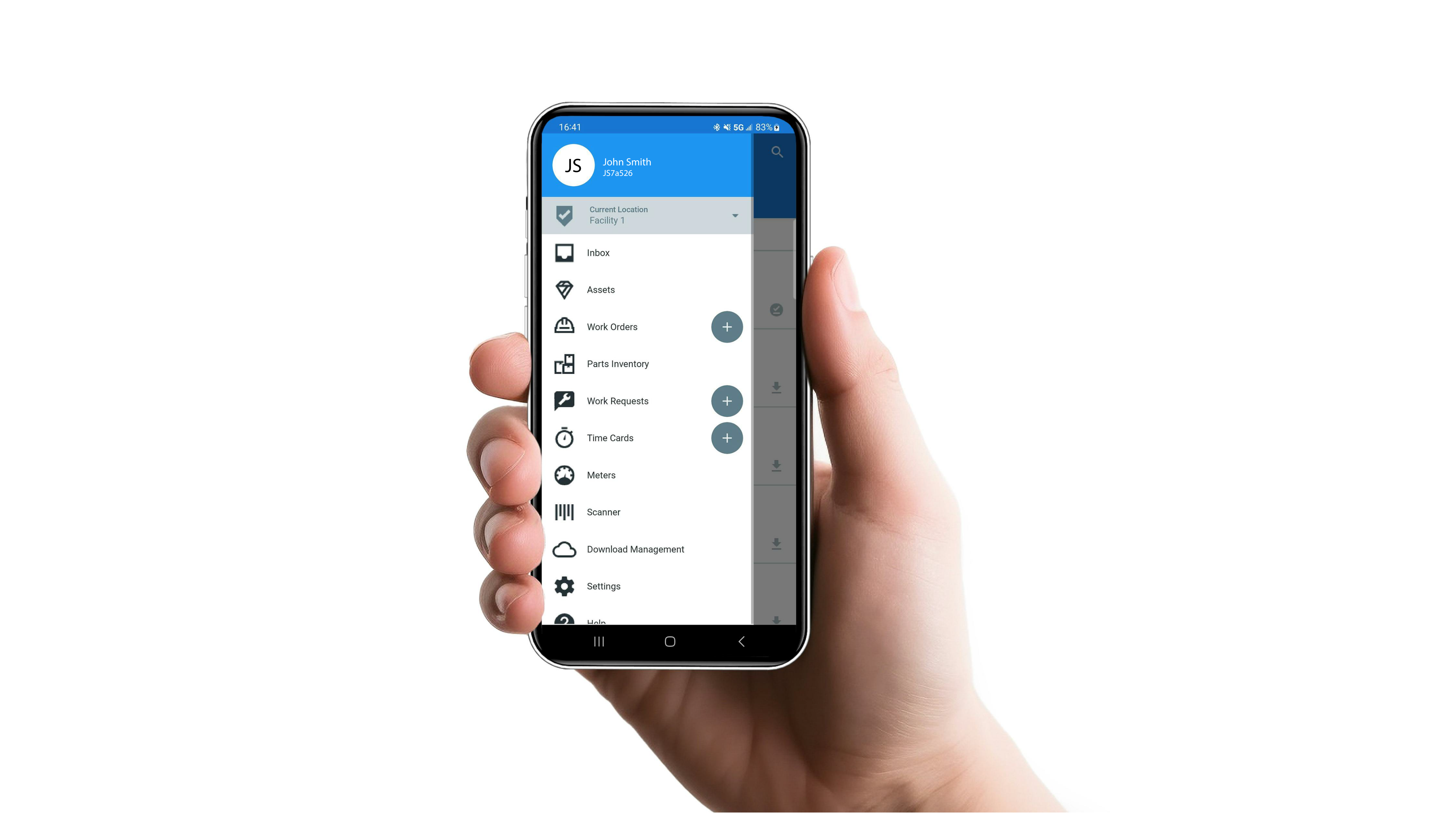
Fig. 1 — CHAMPS Mobile
Work Force Safety
Accidents involving port cranes and other port mobile equipment result in serious injuries and fatalities. Factors contributing to port accidents include; inadequate risk assessment, and operations and maintenance procedures, lack of training and awareness, bigger and faster port equipment, increased port throughputs and faster ship turnarounds.
CHAMPS Permits and Lock-Out/Tag-Out components are vital to port operations as jobs dealing with large, stored energy are handled over certain distances. For example, Hot Works Permit is required for hoist rope changes on STS Container Cranes; LOTO is used when dealing with Horn Pit maintenance. A horn pit is a hole in the ground that electrically connects the STS Container Crane to an electric power sub-station. These pits have submersible pumps to ensure that these electrical connections are not fully submersed in water.
CHAMPS Permits module creates approved documents that describes the permit details, steps and procedures. After the desired permit type has been selected, one can specify the various criteria (i.e., Maintenance Location, Physical Area or a Contained Area, etc.), define special instructions, specific descriptions or monitoring status.
The CHAMPS LOTO Module provides the ability to define enclosures that list steps to establish and restore plant conditions necessary to safely perform work. The system also provides for the definition, printing and control of warning devices (tags) that can be securely fastened to an energy isolating device in accordance with an established procedure. CHAMPS LOTO meets or exceeds Occupational Safety and Health Administration (OSHA) requirements.
A poor safety record and ill-conceived processes are not only detrimental to port personnel, but can result in negative publicity, legal cases, and fines for safety breaches which can severely affect a port's bottom line. Having basic technology in place isn't enough to create a safe and compliant port. Port and terminal management must ensure that technology-backed processes to minimize hazards are put in place and followed by a safety-conscious workforce.
CHAMPS Inspections
CHAMPS CMMS includes an Inspection application designed for managing inspections performed for specified equipment. The application eliminates cumbersome paper trails, ensuring that proper historical data is retained and easily accessed for audits and legal purposes. The CHAMPS Inspections module supports functionality that lets workers document conditions (both expected and unexpected) and then generate work requests and other documents. Managers and other decision makers are then able to instantly review these requests and determine whether to act or not. Real-time feedback keeps both field technicians and managers in a state where they can adapt to changes both quickly and efficiently.
CHAMPS CMMS Analytics
Implementation of CHAMPS CMMS at ports and terminals supports the following generally accepted maintenance strategies:
- Reactive maintenance addressing failures as they occur.
- Preventive maintenance performed on a pre-planned schedule to replace or maintain parts before they fail.
- Predictive maintenance based on analyzing equipment sensors and historical data to predict pending failure and address it proactively.
- Prescriptive maintenance, in which equipment operation is continuously monitored using sensors. Real-time and historical data is then analyzed by advanced software to prescribe specific maintenance activities that ensure optimal equipment uptime.
The approach of, run to failure lets the equipment run until it breaks and then a determination is made if it should be repaired or replaced. This may work for certain types of assets but is not considered a proactive approach like preventive, predictive or prescriptive maintenance.
Applying preventive, predictive or prescriptive maintenance depends on having viable analytics. In some port and container organizations, analytics may not be available to the maintenance departments. CHAMPS CMMS eliminates this problem by delivering integrated analytics as part of the solution for developing dashboards, visual reports and analytics.
For good data analytics, data cleansing and data management strategies are critical. Data is what provides a good predictive or prescriptive maintenance. Analytics also requires collection of strong trend data that can be converted into actionable information.
The following chart (See Fig. 2) derived with the CHAMPS CMMS Analytics for measuring Mean Time Between Failures (MTBF) quantifies the reliability of major equipment at a port.
With this application, ports can make faster and informed decisions by:
- Monitoring MTBF by equipment
- Identifying the most significant causes of failures, and
- Analyzing and defining corrective actions
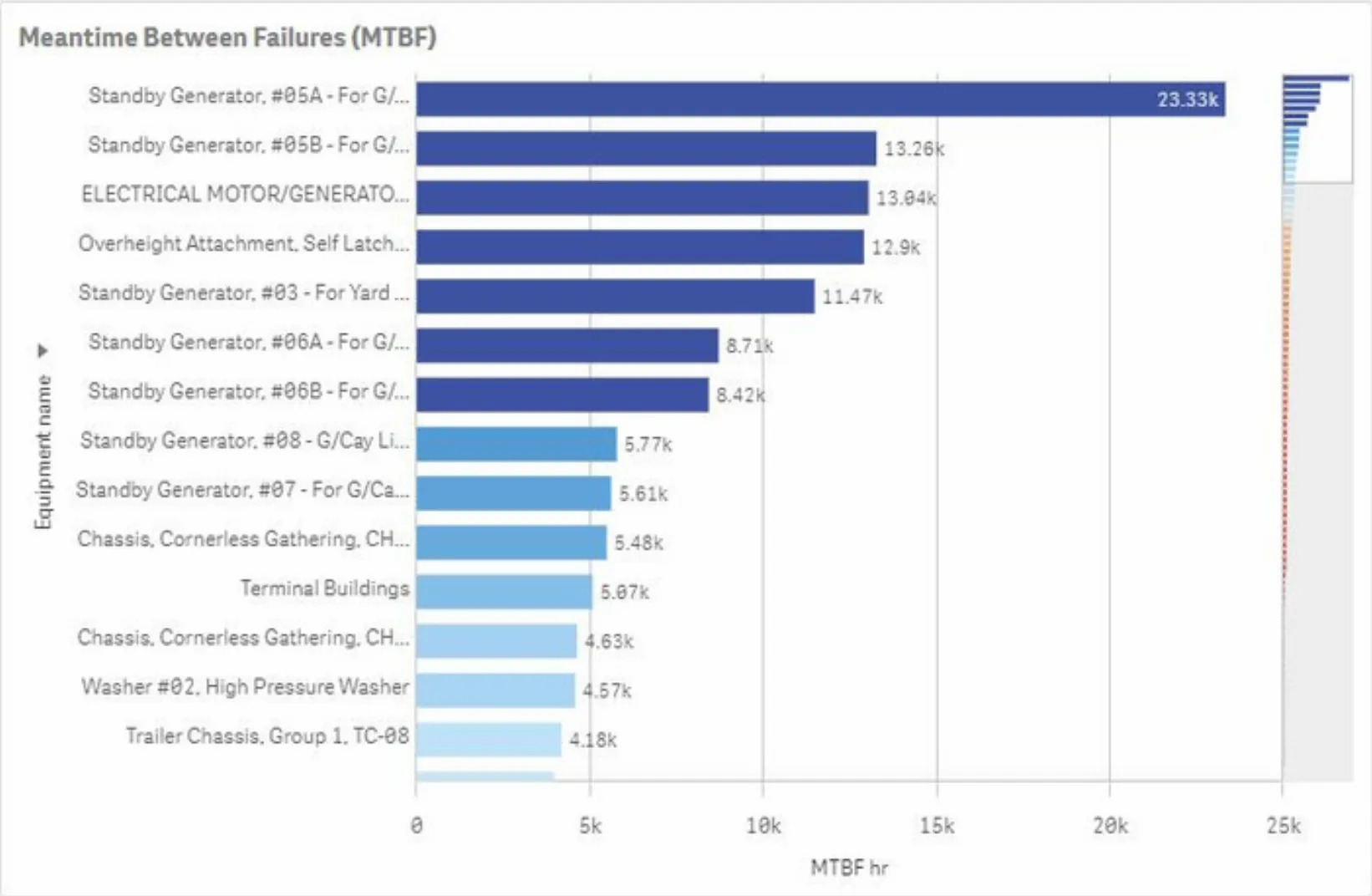
Fig. 2 — CHAMPS Analytics Dashboard
Before ports and terminals can take advantage of analytics, they must make sure they have the right data about the right assets. CHAMPS CMMS establishes a master equipment database. The maintenance and operations management can then decide what is critical. For example, analytics may reveal that preventive maintenance on certain non-critical equipment can be eliminated, saving a great deal of time and money.
Summary
Ports and Terminals can expect the following benefits by optimizing their assets with CHAMPS CMMS and data analytics:
Increased Equipment Uptime
CHAMPS CMMS leads to increasing asset productivity with significantly less downtime as the maintenance workforce identifies and fixes problems correctly the first time.
Reduced Repair Time
Reduce repair time through detailed work planning, identifying the availability of qualified craft persons, tools and parts needed for the jobs and getting all the safety requirements in place.
Increased Crew Productivity
CHAMPS CMMS identifies the properly skilled crew members to complete jobs and projects. The work order scheduling provides for better workload balancing, thereby increasing worker productivity.
Reduced Rework
By providing detailed work procedures, maintenance and repairs are completed correctly the first time resulting in reduced rework.
Reduced Costs
Keep costs in check by reducing unexpected downtime and identifying wasteful spending. Spend your maintenance budget more wisely and maximize your value.
Improved Asset Longevity
Improve the lifespan of your assets through more refined maintenance cycles and methods. CHAMPS CMMS allows you to track maintenance needs in unparalleled detail.